
Managing environmental performanceplus
We recognise the role we play in promoting environmental protection and are committed to conducting our business in a safe and responsible manner, including protecting and minimising the impact of our operations on the environment. We are focused on reducing our environmental impact and aim to continuously improve our performance. Our dedicated Environmental Policy remains available at: investors.eurocell.co.uk. The policy outlines our commitments towards reducing emissions, energy consumption, biodiversity and environmental issues, waste and resource use, water use and the environmental impacts of our products.
Of our manufacturing plants, 50% remain certified to ISO14001:2015. We continue to maintain environmental management systems and have regular inspections to ensure permit compliance at all sites. No environmental fines or penalties have been recorded in 2025 or 2024.
Energy and greenhouse gas emissionsplus
Minimising our carbon emissions and our contribution to climate change is central to our sustainability strategy. Our near term, long-term and Net Zero targets are now validated by SBTi, and having incorporated Alunet’s emissions into our carbon inventory in 2025, we will re-baseline our targets in 2026.
We are also pleased to report the following initiatives progressed in 2025 to reduce our energy consumption and greenhouse gas emissions:
- Having completed installation of solar panels at our main extrusion facility in 2024, this system yielded nearly 1,000,000 kWh of electricity in 2025
- Completed further solar panel installations at our Head Office and Distribution Centre in 2025, which yielded nearly 200,000 kWh of electricity during the year
- Completed the transition from LPG to electric forklifts at our manufacturing and distribution sites. Whilst we still operate gas forklifts in the Branch Network, they are low usage
- Maintained the proportion of renewable electricity we procure, achieving 95% in 2025 and 2024
- Continued to work on fleet and van optimisation across the business, with all Branch Network vehicle and recycling f leet telematics installations completed in 2025. The objective of telematics is to reduce costs and emissions by improving the efficiency of route planning and load maximisation
- LED lighting installations completed at Alunet Systems and JDUK.
Energy consumption and emissions data
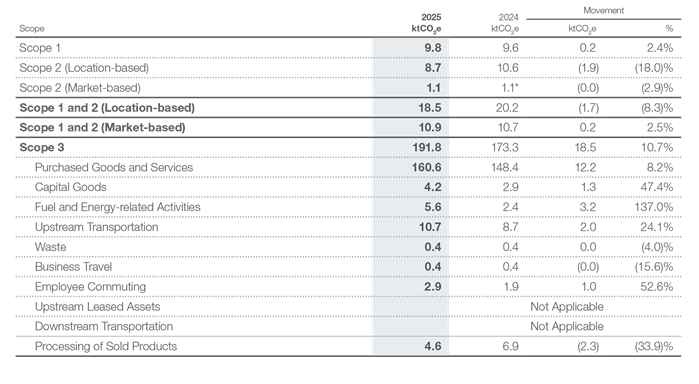
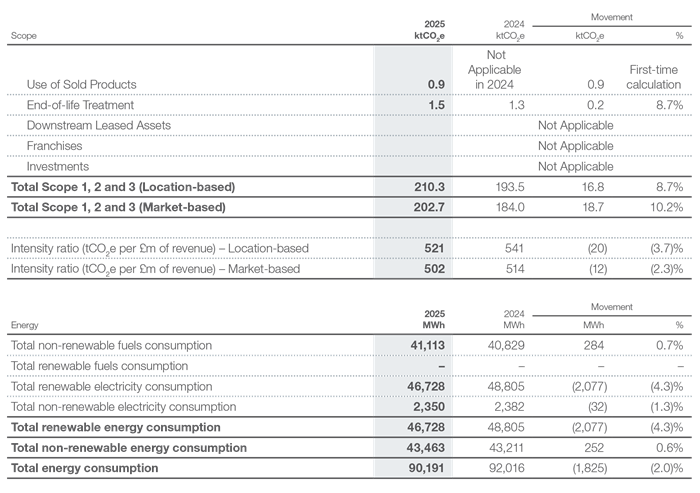
We have continued to refine our end-to-end carbon footprint methodology, which includes a full emissions analysis for 2024 and 2025, as set out in the table below. 2025 emissions data includes Alunet from the acquisition in March.
Notes to table:
- We operate only within the United Kingdom and so values are for UK operations only
- * An error in an emissions factor was identified in the Scope 2 (Market-based) calculation in FY24. This has been restated in the emissions table where appropriate.
Notes to calculations:
- Emissions and energy data presented for 2024 and 2025 is based on management estimates
- To calculate our emissions and energy usage data, we have followed the 2019 UK Government environmental reporting guidance. We have used the GHG Protocol Corporate Accounting and Reporting Standard (revised edition). The Greenhouse Gas Protocol standard covers the accounting and reporting of seven greenhouse gases covered by the Kyoto Protocol. We are reporting our Scope 3 emissions, with guidance from the GHG Protocol Corporate Value Chain (Scope 3) Accounting and Reporting Standard and the GHG Protocol Technical Guidance for Calculating Scope 3 Emissions, as required
- We have reported on all of the material emission sources from within the operational boundaries of the Group, as required under the Companies Act 2006 (Strategic Report and Directors’ Reports) Regulations 2013 and under the UK’s Streamlined Energy and Carbon Reporting (‘SECR’) requirements
- The Group has defined its organisational boundary using an operational control approach. Our reporting of Scope 1 and 2 emissions and energy data covers 100% of our global operations. Furthermore, our reporting of Scope 3 emissions covers 100% of our upstream and downstream value chain
- The emission factors from the UK Government’s GHG Conversion Factors for Company Reporting 2025 (the Department for Energy Security & Net Zero (‘DESNZ’) factors) have been used for all Scope 1 and 2 categories and the majority of Scope 3 categories. For spend-based calculations, the UK Environmentally-Extended Input-Output (‘EEIO’) model factors were used. For weight-based calculations, EcoInvent and Idemat factors were used
- In line with the Greenhouse Gas Protocol, we continue to review our reporting in light of any changes in business structure, calculation methodology and the accuracy or availability of data.
Energy consumption and emissions performance
Our Scope 1 emissions increased slightly year-on-year, due to gas consumption at Alunet and increased LPG consumption for packaging at Vista. This was partially offset by fuel decreases at our main operational sites, where we have replaced 14 LPG trucks with 9 electric trucks at the end of 2024. Periods of operational downtime due to plant breakdowns in the recycling business also reduced the fuel consumed by our core fleet.
Location-based Scope 2 emissions fell 18% to 8.7 ktCO2e, largely due to a decrease in the appropriate DESNZ emissions factor. Market-based Scope 2 emissions remained stable at 1.1 ktCO2e. Eurocell Recycling North (ERN), where the landlord contracts for power on our behalf, remains the only Eurocell facility without a renewable electricity contract. However, as noted elsewhere in this Annual Report, following a site consolidation project, we expect to exit ERN at the end of 2026.
In combination, our location-based Scope 1 and 2 emissions (18.5 ktCO2e) have decreased by 8% compared to 2024, whereas our market-based Scope 1 and 2 emissions (10.9 ktCO2e) have increased by 3% compared to 2024.
We have calculated our Scope 3 emissions for 2025 to be 191.8 ktCO2e, compared to 173.3 ktCO2e in 2024, an increase of 11%. This reflects the incorporation of Alunet into our footprint, which particularly has driven the increase in our Category 4 (Upstream Transportation) emissions. Substantial increases in some EEIO emissions factors used in our spend-based calculations (see notes to calculations) has also led to the increases in our Category 1 (Purchased Goods & Services) and Category 2 (Capital Goods) emissions.
We have improved our Category 3 (Fuel and Energy-related Activities) calculation methodology this year, to better account for the type of renewable instrument through which the majority of our electricity is procured, which has caused these emissions to increase by 137%. Methodology improvements were also implemented in Category 7 (Employee Commuting) which has caused these emissions to increase by 53%. These increases were not material to our overall footprint, however, so no restatement of 2024 figures were required.
Category 10 emissions (Processing of Sold Products) decreased year-on-year, largely because less PVC pellets were sold externally and customer electricity use per tonne of profile fabricated decreased, alongside a decrease in the UK emissions factor for electricity.
We have incorporated Category 11 (Use of Sold Products) into our carbon inventory for the first time this year, to capture electricity use associated with motor powered doors sold by Alunet.
Overall, our total (Scope 1, 2 and 3) location-based emissions have increased by 9%, and total market-based emissions increased by 10%, compared to 2024, largely due to the inclusion of Alunet emissions from March. As a result, after including Alunet revenues, energy intensity stayed reasonably consistent year on year.
Our total energy consumption (90,191 MWh) decreased slightly (2%) compared to 2024, reflecting lower year-on-year production at Eurocell, partially offset by the impact of Alunet.
Water consumptionplus
Our main use of water is in the cooling process for extrusion, but it is also used to wash scrap PVC, remove impurities in our recycling operations and for employee welfare.
We have a closed loop water recycling system in extrusion, and water supply bills are scrutinised for abnormalities that would indicate a leak, following which the water provider would be contacted for repair.
The system significantly reduces the environmental impact of our processes, by conserving local water resources and reducing the amount of contaminated or unfiltered water entering back into the local environment. Minimising consumption and therefore reducing disposal costs also has a financial benefit to our business.
We use only potable water, supplied directly by the water provider, which is suitable for drinking. We do not abstract any ground or surface water. None of our sites are located in high flood-risk areas and all sites are provided with adequate welfare facilities, in accordance with governing legislation.
Water usage was identified as a key issue for our stakeholders in our ESG materiality assessment. Over the last few years, we have strengthened our material recovery, including improved water circularity. We will continue the work to improve our water usage data collection, and thereafter to define targets to increase water efficiency in our operations. This is dependent on investment and process changes to improve our existing closed-water loop cooling systems.
Waste managementplus
Our business and operations result in waste, and we are committed to controlling, recovering and reusing waste wherever possible. We promote the efficient use of resources and materials across our facilities to help reduce waste. We have a sustainable procurement policy, and we actively seek to source sustainable products from suppliers that are made from recycled material where possible.
2025 data in the table below includes Alunet from the acquisition in March.
| Total waste (kt) | 2025 | 2024 |
| To landfill | 1.0 | 0.6 |
| Recycled | 17.5 | 16.6 |
| Diverted from landfill | 8.3 | 6.9 |
| Total | 26.8 | 24.1 |
We continue to work towards our commitment to send a maximum of 1% of waste to landfill by 2030, and are pleased to have met our interim target (5% by 2025) this year, with only 4% of our total waste sent to landfill.
However, our waste recycled proportion fell to 65% in 2025 (2024: 69%), as we have worked to clear the volume of by-product stored at our recycling sites in preparation for our site consolidation plans, as well as our third-party waste collector’s preference to incinerate rather than recycle waste. We will continue engaging with our third-party providers to ensure as much of our waste is recycled as possible. Including Alunet has also impacted the overall recycling proportion, with all waste was assumed to go to landfill. We therefore did not meet our interim target to achieve 88% of waste recycled by 2025, but remain committed to the target to achieve 93% of waste recycled by 2030.
To support delivery of these targets, we will continue to adopt our waste management plan and focus on improving the processing of by-products from our recycling process (metal, rubber, wood). At third-party sites, which act as collection and delivery hubs for old windows which have been replaced, we are implementing processes that allow for cleaner waste streams. We will also continue to develop partnerships with waste services providers, to optimise end-to-end material recovery.
Packaging accounts for c.5% of the waste we generate. We aim to reduce this by using thinner materials and packaging with more recycled content, both for our own products and in the delivery of raw material to our sites.
Hazardous materialsplus
We do not use significant amounts of hazardous materials. In our extrusion business, we do not use phthalates, cadmium or lead-based stabilisers.
In our recycling operation we monitor the cadmium and lead contamination levels within feedstock, to ensure compliance with governing legislation.
Very small quantities of other hazardous materials are currently used as additives within our product mix, but these are rendered non-bioavailable when encapsulated by the polymer structure. In addition, we have a specific requirement within our new product introduction process to reduce any use of hazardous materials.
- Previous People First
- Next Sustainable Products